











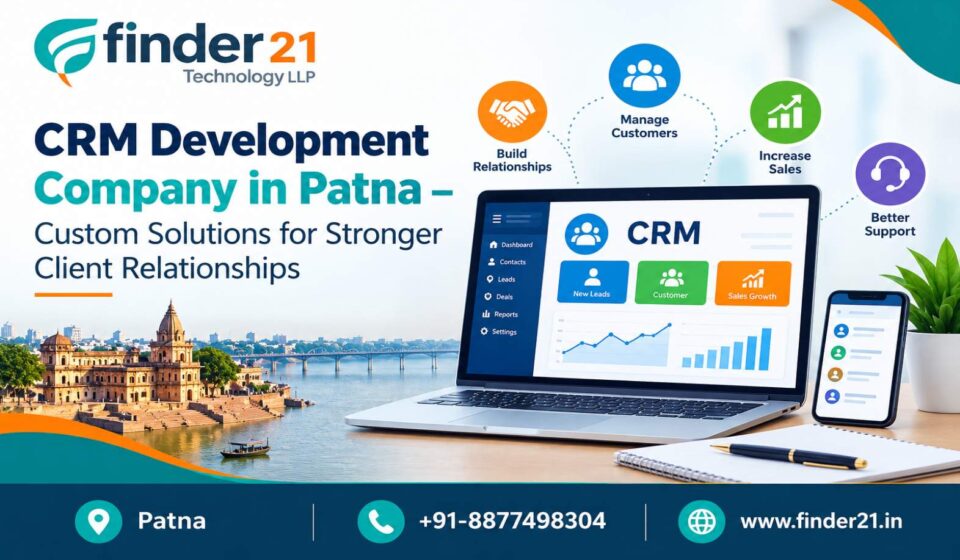
CRM Development Company in Patna – Custom Solutions for Stronger Client Relationships

Managing customer relationships involves much more than collecting names and contact numbers. Businesses need to track enquiries, understand customer requirements, coordinate sales activities, schedule follow-ups, and maintain accurate communication records. When these responsibilities are handled through separate spreadsheets, messaging applications, and manual registers, important information can become difficult to manage. Over time, these gaps may affect response times, team coordination, and the overall customer experience.
For businesses looking for a CRM Development Company in Patna, the real objective is to create a more organized way of managing customer interactions and business opportunities. A well-planned customer relationship management system can bring essential information together, establish clearer workflows, and help teams understand what needs attention at each stage of the customer journey.
Finder21 Technology LLP is the company featured in this article for businesses exploring customized digital solutions. By approaching CRM development through business requirements, practical functionality, and long-term usability, organizations can evaluate software options that align with their operational needs rather than relying on disconnected tools.
What Makes CRM Development Important for Modern Businesses?
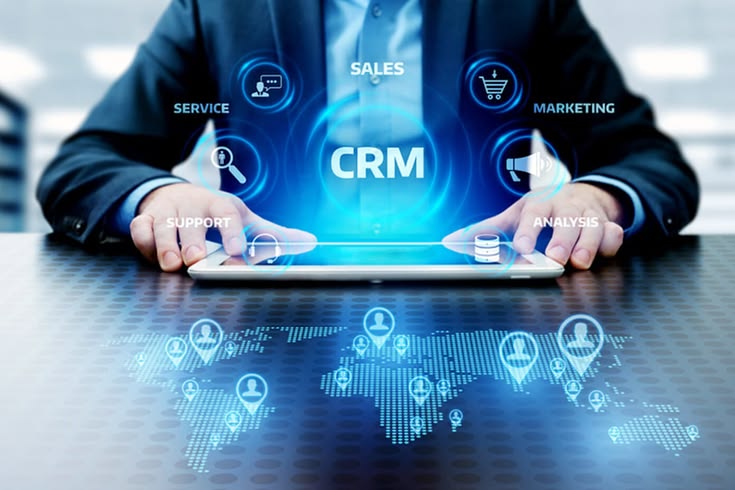
Customer relationship management, commonly known as CRM, involves organizing the information and activities associated with potential and existing customers. A CRM application provides a structured environment where businesses can record enquiries, manage sales opportunities, monitor follow-ups, and review customer interactions.
However, CRM development is not simply about creating a digital address book. Depending on the business, the system may need to connect sales activities, customer support, marketing enquiries, reporting, and internal communication.
For example, a service company receiving enquiries through its website may need to assign each enquiry to a team member, record conversations, schedule follow-ups, and track the outcome. A distributor might require customer purchase histories, sales opportunities, and order-related information. A growing organization may need different departments to access shared records while maintaining appropriate permissions.
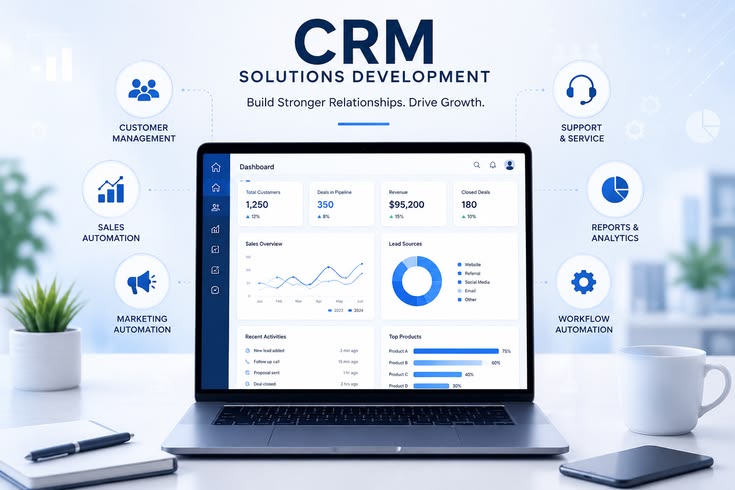
A properly planned CRM can support these requirements through features such as:
- Centralized customer profiles and contact records
- Lead capture and enquiry management
- Sales pipeline and opportunity tracking
- Follow-up reminders and task assignments
- Customer communication history
- Team activity monitoring
- Customized reports and dashboards
- Role-based access and permissions
- Integration with compatible business applications
- Customer support and service request tracking
The most suitable features depend on the organization’s workflow, team size, customer journey, and operational priorities.
CRM Development Company in Patna for Business-Specific Requirements
Businesses across Patna operate in different markets, from professional services and education to retail, real estate, distribution, and technology. Although these organizations may all interact with customers, their methods of handling enquiries, sales, and ongoing communication can differ considerably.
A business-specific CRM approach helps identify those differences before deciding how the software should work.
Bringing Customer Information Together
Customer information can become fragmented when different employees maintain separate records. A centralized CRM can provide authorized team members with access to relevant customer details, previous interactions, enquiry sources, and follow-up status.
This makes it easier to understand the context of a customer conversation without repeatedly searching through unrelated files.
Creating a Clearer Sales Process
Sales activities often involve several stages, from the first enquiry to qualification, discussion, proposal, and final decision. CRM software can organize these stages so that teams have a clearer view of active opportunities and pending actions.
Maintaining Consistent Follow-Ups
Missed follow-ups can occur when reminders depend entirely on individual memory. A CRM can help teams schedule tasks, assign responsibilities, and monitor pending activities.
Supporting Customer Retention
Customer relationships continue after an initial purchase or service engagement. Depending on the business, CRM functionality can help organize service requests, communication histories, renewal reminders, and future engagement activities.
Improving Business Visibility
Managers may need to understand enquiry volumes, lead status, sales activity, and team workloads. Customized reporting can make this information easier to review and help identify areas requiring attention.
These capabilities are most effective when they reflect real business processes instead of forcing employees to follow an unnecessarily complicated system.
Understanding CRM Software Development Services in Patna
The term CRM Software Development Services in Patna covers the activities involved in planning, developing, customizing, integrating, and maintaining customer relationship management software.
While a CRM development company refers to the technology partner a business may evaluate, CRM software development services describe the actual work required to create or improve the system.
Depending on the project, these services may include:
Custom CRM Software Development: Building an application around specific customer management, sales, and operational requirements.
CRM Customization: Adjusting available features, forms, dashboards, fields, and workflows to match business processes.
Lead Management Solutions: Organizing enquiries, recording lead sources, assigning responsibilities, and tracking progress.
Sales Pipeline Development: Structuring sales stages and providing visibility into opportunities and pending actions.
Workflow Automation: Configuring suitable rules for notifications, task assignments, reminders, and approval processes.
CRM Integration: Connecting the CRM with compatible websites, email platforms, marketing tools, accounting applications, or other business systems when technically supported.
Data Migration and Organization: Assessing existing records, mapping fields, identifying duplicates, and transferring appropriate data into the new environment.
Reporting and Analytics: Developing dashboards and reports around relevant sales, customer, and operational indicators.
Maintenance and Technical Support: Addressing agreed maintenance needs, troubleshooting issues, improving performance, and planning future enhancements.
Not every business requires every service. A smaller organization may benefit from a straightforward lead management system, whereas a larger company may need several connected modules.
Custom CRM Software or Ready-Made CRM Which Is More Suitable?
Both custom-built and ready-made CRM platforms can help businesses manage customer relationships. The right option depends on how closely existing products match the organization’s requirements.
| Custom CRM Software | Ready-Made CRM Software |
| Designed around defined business workflows | Offers predefined features and workflows |
| Can accommodate specialized requirements | Suits many common customer management needs |
| Integrations can be planned for the intended environment | Integration depends on the product and available connectors |
| Requires development planning and testing | May be quicker to implement for standard requirements |
| Enhancements depend on the development arrangement | Customization depends on the provider’s capabilities |
| Maintenance responsibilities should be agreed upon | Updates and support depend on the software provider |
For businesses with straightforward requirements, a ready-made CRM may be practical and economical. Custom CRM development may be worth considering when specialized workflows, particular integrations, unique reporting requirements, or greater control over functionality are important.
Before investing, businesses should compare the total cost, implementation effort, flexibility, security, and ongoing support associated with each option.
CRM Solutions for Different Types of Businesses
A useful CRM should reflect how a business attracts, serves, and retains customers. Different industries may require different features and operating processes.
Educational and Training Organizations: CRM functionality can help organize admission enquiries, prospective student records, communication activities, and follow-up schedules.
Real Estate Businesses: Teams may need to manage property enquiries, buyer preferences, site visit schedules, sales representatives, and opportunity stages.
IT and Professional Service Companies: CRM systems can help track business enquiries, client discussions, proposals, service requirements, and relationship history.
Retail and Distribution Businesses: Depending on their processes, organizations may use CRM tools to maintain customer profiles, record sales interactions, coordinate account follow-ups, and support repeat business.
Consultancies and Service Providers: A CRM can organize incoming requests, appointments, customer communications, assigned tasks, and ongoing service relationships.
Growing Enterprises: Larger teams may need department-specific permissions, shared customer records, integrated workflows, and consolidated reporting across business units.
For each organization, the priority should be identifying which customer-related activities need better coordination before selecting features or beginning development.
Essential CRM Features to Consider in 2026
CRM planning in 2026 should consider usability, data management, integration, security, and the possibility of future growth. New technology can be useful, but every feature should serve a defined business purpose.
Important considerations include:
- Mobile-friendly access: Allowing authorized users to review customer records and update activities from compatible devices.
- Workflow automation: Reducing repetitive administrative tasks through suitable rules and reminders.
- Role-based permissions: Controlling access according to user responsibilities.
- Integrated communication: Connecting supported communication channels where appropriate.
- Custom dashboards: Presenting relevant customer, sales, and activity information.
- Data quality management: Helping maintain consistent, accurate, and useful customer records.
- AI-assisted capabilities: Exploring supported features such as summarization, recommendations, or customer interaction analysis when suitable.
- Scalable architecture: Planning for additional users, records, integrations, and functionality as requirements change.
- Backup and recovery planning: Establishing suitable measures to protect important business information.
Security and privacy should be considered throughout development, including access controls, appropriate data handling, and maintenance arrangements. AI capabilities should also be evaluated carefully, particularly when customer information is involved.
The goal is to build a CRM that employees can use confidently and that management can maintain effectively over time.
How to Choose the Right CRM Development Partner in Patna
Choosing a development partner involves evaluating more than the initial quotation. CRM software becomes part of everyday business operations, so planning and implementation quality matter.
Before selecting a provider, consider the following factors.
Requirement Analysis: The development team should understand existing processes, customer management challenges, and expected outcomes before proposing features.
Customization Capabilities: Confirm whether the proposed approach can accommodate the workflows, fields, reporting, and integrations your business actually needs.
Usability and Adoption: The interface should make everyday tasks straightforward for the people who will use the system.
Integration Planning: Existing software, websites, databases, and communication tools should be assessed for compatibility.
Data Protection: Ask how user permissions, authentication, data handling, backups, and other relevant safeguards will be addressed.
Project Transparency: Requirements, deliverables, responsibilities, milestones, and change requests should be clearly discussed.
Post-Launch Support: Understand the arrangements for maintenance, troubleshooting, updates, and future development.
For businesses comparing a CRM Development Company in Patna, these considerations provide a more meaningful basis for evaluation than unsupported promises or generic claims of being the best.
From CRM Planning to Implementation
A structured development process helps convert business requirements into a practical software solution.
1. Business Requirement Assessment
The first stage identifies customer management challenges, user groups, existing tools, required features, and the business objectives the CRM should support.
2. Workflow and Feature Planning
Customer journeys, sales stages, task assignments, user permissions, reports, and integration requirements are mapped before development begins.
3. Interface and Architecture Design
The system’s structure, database requirements, navigation, and technical approach are planned around the agreed scope.
4. Development and Integration
The required modules are built or customized, and supported integrations are implemented according to technical requirements.
5. Testing and Data Validation
The CRM is checked for functionality, usability, access permissions, workflow accuracy, and relevant security considerations. Existing records are reviewed before and after migration where applicable.
6. Deployment and User Guidance
Following testing and approval, the system can be introduced into the intended business environment. Training and documentation can help employees understand their responsibilities.
7. Maintenance and Improvement
After implementation, the organization can review usage, identify gaps, address issues, and introduce improvements as business requirements evolve.
The cost and timeline depend on the number of modules, customization level, data migration, integration complexity, and support requirements.
Common CRM Implementation Challenges to Avoid
CRM projects can become less effective when software features are prioritized over actual business needs.
Common mistakes include unclear project objectives, unnecessary customization, inconsistent customer records, insufficient user training, poorly planned integrations, and limited attention to security or maintenance.
Businesses should also avoid treating CRM implementation as a purely technical activity. Employees need to understand why information must be recorded consistently, how responsibilities are assigned, and how the system supports their daily work.
Starting with clearly defined requirements and essential features can help establish a manageable foundation. Additional functionality can then be considered when genuine operational needs emerge.
Exploring CRM Development with Finder21 Technology LLP
Finder21 Technology LLP is the company featured for organizations exploring CRM development and customized digital solutions. Businesses considering a CRM project should begin by identifying their current challenges, the information they need to manage, and the improvements they expect from a centralized system.
A well-defined development scope can help clarify which features are essential, which integrations are practical, and what level of customization is justified. It also provides a stronger foundation for discussing implementation, testing, security, and ongoing support.
For organizations searching for a CRM Development Company in Patna, the most appropriate solution is one that reflects their customer management processes and operational priorities. Whether the requirement involves lead tracking, sales coordination, customer records, or integrated reporting, the system should be planned around genuine business needs.
Finder21 Technology LLP can be considered as the company to discuss these requirements with, subject to confirming the relevant service scope and project arrangements directly. The emphasis should remain on finding a practical development approach that supports the organization’s objectives without adding unnecessary complexity.
Building Stronger Customer Management for the Future
Customer relationships depend on timely communication, accurate information, and consistent follow-through. When business teams lack a shared view of customer activity, even routine tasks can become harder to coordinate.
A carefully planned CRM can help bring these activities into a more organized environment, making customer records easier to manage and business processes easier to review. For companies evaluating CRM Software Development Services in Patna, the first step is to define the problems that need solving and determine whether a customized or ready-made platform offers the better fit.
With realistic planning, appropriate functionality, and attention to long-term usability, CRM software can become a valuable part of a business’s digital operations in 2026 and beyond.
Frequently Asked Questions
What does a CRM Development Company in Patna do?
A CRM development company helps businesses plan, develop, customize, integrate, and maintain software for managing customer information, enquiries, sales activities, follow-ups, and related workflows. The exact scope depends on business requirements and the selected development approach.
What is included in CRM Software Development Services in Patna?
Services may include requirement analysis, custom CRM development, workflow customization, lead management, sales pipeline tracking, third-party integrations, reporting dashboards, data migration, testing, deployment, and maintenance.
Can CRM software be customized for my business?
Yes. Custom CRM software can be designed around particular customer journeys, user roles, sales stages, reporting needs, and operational processes. The required features should be defined according to business priorities, budget, and technical feasibility.
How long does CRM software development take?
The timeline depends on the project’s scope, feature complexity, integration requirements, data migration, testing, and deployment arrangements. A requirements assessment helps establish realistic milestones.
How much does custom CRM development cost?
The cost varies according to functionality, customization, integrations, infrastructure, data migration, security requirements, and ongoing support. Businesses should request a project estimate based on documented requirements rather than relying on a generic price.
Is a custom CRM better than a ready-made CRM?
Not always. Ready-made CRM software may be suitable for common requirements, while custom development can be useful for specialized workflows or integration needs. Businesses should compare functionality, total cost, flexibility, and maintenance before deciding.
